The Epigraph
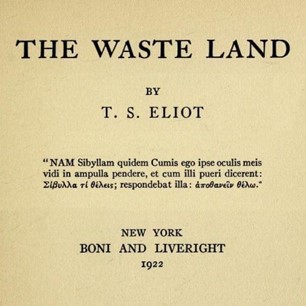
T.S. Eliot’s “The Waste Land” begins with an untranslated epigraph in Latin and Greek. That, in itself, forewarns the reader of the difficult task ahead: This is not going to be an easy work to read, and it may require some digging on the reader’s part. Then there’s the dedication to Ezra Pound, in Italian. Perhaps he should have thrown some Chinese or double Dutch in there, too, just to complete the welcome.
When the book edition appeared in 1922, Eliot provided the following translation in the notes: “For once I myself saw with my own eyes the Sibyl at Cumae hanging in a jar, and when the boys said to her: ‘Sibyl, what do you want?’ she replied: ‘I want to die.’”
The quote is from The Satyricon, by Titus (some say Gaius) Petronius, written in the first century CE. With a little license, you could translate it as “The Book of Satyric Shenanigans”, which is and is not a fitting title. It reads almost as porn in some parts, but there is a lot more to it than that. Beyond the bawdiness, it is a genuinely biting satire of 1st-century Roman life (perhaps under Nero) and a parody of epic literature.
To give a little context, here is the passage in which the epigraph appears in The Satyricon, taken from Oscar Wilde’s translation:
Whilst they were still acclaiming these and similar remarks with fulsome praise, [Trimalchio] resumed, “Pray, my dearest Agamemnon, do you recollect by any chance the twelve labours of Hercules, or the story of Ulysses, how the Cyclips twisted his thumb out of joint, after he was turned into a pig. I used to read these tales in Homer when I was a lad. Then the Sibyl! I saw her at Cumae with my own eyes hanging in a jar; and when the boys cried to her, ‘Sibyl, what would you?’ she would answer ‘I would die’ — both of ‘em speaking Greek.”
The Satyricon follows the well-born rogue Encolpius and his slave Giton as they skip from one escapade to the next, all the while highlighting the vulgarity, pretentiousness, hollowness, and general wantonness of Roman life. Encolpius’s labors, mostly sexual in nature, are a spoof on the twelve heroic labors of Hercules, while his wanderings around Rome and environs, engaging in, and often being subjected to, every imaginable form of debauchery, are a hollowed-out, degenerate riff on Odysseus’s epic return home from Troy. Giton is part Telemachus, part Patroclus, but Encolpius is no Odysseus or Achilles, and the various figures he shags/is shagged by along the way are far from the epic characters they parody. Unlike Homer’s formidable nymph, Petronius’s sex-crazed Circe is nothing at all like the dazzling sorceress. In fact, her only magical power seems to be to expose poor Encolpius’ impotence. There’s an Agamemnon here, too, but he’s a far cry from Homer’s strongman king. A teacher of rhetoric, he’s all show over substance, form without content. And then there’s Trimalchio, the late-Roman answer to the great kings of old. He has tremendous wealth and economic power, but he’s a clown, a farce of a man, more likely to instill bemusement than inspire fear or admiration, despite his best efforts.
Trimalchio, who utters the words in Eliot’s epigraph, is a Roman equivalent of a modern-day billionaire: profligate, vulgar, pretentious, out of touch with reality, and tasteless in every possible way. While techbros today may be pursuing nutty ways to secure unnatural longevity, Trimalchio seeks immortality by planning the most lavish funeral and tomb the world has ever seen. And it’s from this guy’s mouth that we get our first clue as to what Eliot’s poem is and intends to do. The Satyricon is a parody and a satire, “The Waste Land” is, as we’ll see in the next post, an elegy and a lament, but they both address some of the same themes: moral and cultural decay and excess; intellectual life focused on style over content (no art and bad art—the ancient myths and masterpieces no longer guiding us, but merely showing how far we have fallen); a shifting sense of self and fragmented identity (playing roles rather than simply being—“He Do The Police in Different Voices” was Eliot’s original title); Corrupted sexuality (the sex shown is transactional, often competitive, sometimes humiliating, a way of showing power, or just simple abandon); the emptiness of ritual(religious and secular—“Unreal city…”); and alienation and loss of meaning.
Both Eliot’s elegy and Petronius’ satire depict waning empires in the throes of moral collapse. But where Petronius has a laugh doing it, Eliot has a breakdown.
His first choice for the epigraph, which Ezra Pound dissuaded him from using, was perhaps more indicative of that state of mind. It was from Joseph Conrad’s Heart of Darkness, and it was spoken by Kurtz:
“The horror! The horror!”
What horror was this? It was the horror of colonialism and empire, the horror of the human soul and the evil of which it is capable, the horror of existential dread, the horror of the collective and individual shadow cast upon the world, the horror of the nothingness that frames being. It was the horror of all of that at once, paraded before him in the sweltering jungle of the Congo.
Kurtz saw what Trimalchio had only intuited (hence his morbid fascination with his death). And that is perhaps why Trimalchio’s almost gossipy aside about the Sibyl at Cumae works better as an epigraph for this poem, because the Sibyl had certainly seen that horror and grown so weary of it that all she could do was pray for death. In other words, “The horror, the horror” might have been too on the nose for a poem that is all about peeking behind veils rather than tearing them down.
So when the Sibyl says “I want to die”, she is really declaring the same horror as Kurtz in his burning jungle kingdom and the same horror as Eliot himself as he connected “nothing with nothing” on Margate sands (III The Fire Sermon).
So, before we begin the poem proper (next post), I take the liberty to suggest a tweaked version of the epigraph:
“For once I myself saw with my own eyes the Sibyl at Cumae hanging in a jar, and when the boys said to her: ‘Sibyl, what do you see?’ she replied: ‘The horror. The horror.’”
Next post: Lines 1-7
 Anthony Doyle